what command would create the link s03mdadm to ../init.d/mdadm?
This browser is no longer supported.
Upgrade to Microsoft Edge to have advantage of the latest features, security updates, and technical back up.
Working across Windows and Linux file systems
In that location are a number of considerations to keep in mind when working between Windows and Linux file systems. Nosotros have outlined a few of them for you in this guide, including some examples of interoperability support for mixing Windows and Linux-based commands.
File storage and performance across file systems
Nosotros recommend against working across operating systems with your files, unless yous have a specific reason for doing and so. For the fastest operation speed, store your files in the WSL file system if you are working in a Linux control line (Ubuntu, OpenSUSE, etc). If you're working in a Windows command line (PowerShell, Control Prompt), shop your files in the Windows file system.
For example, when storing your WSL project files:
- Use the Linux file arrangement root directory:
\\wsl$\Ubuntu\home\<user name>\Project - Non the Windows file arrangement root directory:
/mnt/c/Users/<user proper name>/Projection$orC:\Users\<user name>\Project
When you see /mnt/ in the file path of a WSL command line, it ways that you are working from a mounted drive. So the Windows file organization C:/ drive (C:\Users\<user name>\Projection) will wait like this when mounted in a WSL control line: /mnt/c/Users/<user name>/Projection$. It is possible to store your project files on a mounted drive, but your operation speed will improve if you store them directly on the \\wsl$ drive.
View your current directory in Windows File Explorer
You can view the directory where your files are stored by opening the Windows File Explorer from the command line, using:
explorer.exe . Alternatively, you lot can likewise utilize the command: powershell.exe /c starting time . Be sure to add the flow at the end of the control to open the current directory.
To view all of your available Linux distributions and their root file systems in Windows File explorer, in the accost bar enter: \\wsl$
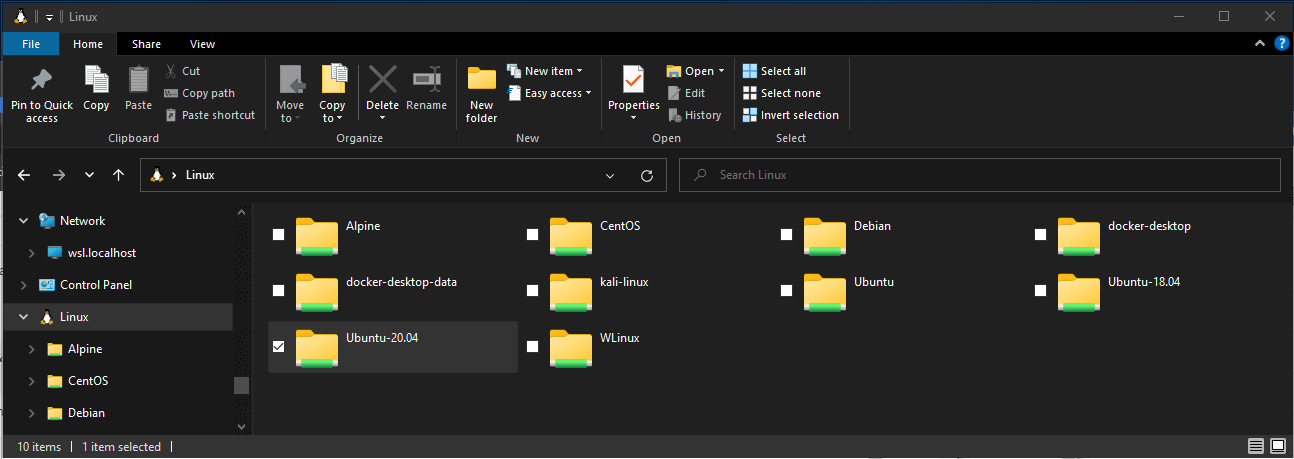
Filename and directory case sensitivity
Example sensitivity determines whether uppercase (FOO.txt) and lowercase (foo.txt) messages are handled as singled-out (example-sensitive) or equivalent (instance-insensitive) in a file name or directory. Windows and Linux file systems handle case sensitivity in dissimilar ways - Windows is case-insensitive and Linux is instance-sensitive. Larn more nigh how to arrange case sensitivity, specially when mounting disks with WSL, in the Adjust case sensitivity how-to article.
Interoperability between Windows and Linux commands
Windows and Linux tools and commands tin can be used interchangeably with WSL.
- Run Windows tools (ie. notepad.exe) from a Linux command line (ie. Ubuntu).
- Run Linux tools (ie. grep) from a Windows command line (ie. PowerShell).
- Share surroundings variables betwixt Linux and Windows. (Build 17063+)
Run Linux binaries from the Windows Command Prompt (CMD) or PowerShell using wsl <control> (or wsl.exe <command>).
For example:
C:\temp> wsl ls -la <- contents of C:\temp -> Binaries invoked in this way:
- Use the same working directory every bit the current CMD or PowerShell prompt.
- Run as the WSL default user.
- Have the same Windows administrative rights every bit the calling process and terminal.
The Linux command following wsl (or wsl.exe) is handled similar any command run in WSL. Things such every bit sudo, piping, and file redirection piece of work.
Example using sudo to update your default Linux distribution:
C:\temp> wsl sudo apt-go update Your default Linux distribution user name will exist listed afterward running this command and y'all will be asked for your password. Later entering your countersign correctly, your distribution volition download updates.
Mixing Linux and Windows commands
Here are a few examples of mixing Linux and Windows commands using PowerShell.
To use the Linux command ls -la to listing files and the PowerShell command findstr to filter the results for words containing "git", combine the commands:
wsl ls -la | findstr "git" To apply the PowerShell control dir to listing files and the Linux command grep to filter the results for words containing "git", combine the commands:
C:\temp> dir | wsl grep git To use the Linux command ls -la to listing files and the PowerShell command > out.txt to print that list to a text file named "out.txt", combine the commands:
C:\temp> wsl ls -la > out.txt The commands passed into wsl.exe are forwarded to the WSL process without modification. File paths must be specified in the WSL format.
To use the Linux command ls -la to listing files in the /proc/cpuinfo Linux file organization path, using PowerShell:
C:\temp> wsl ls -la /proc/cpuinfo To use the Linux command ls -la to list files in the C:\Program Files Windows file system path, using PowerShell:
C:\temp> wsl ls -la "/mnt/c/Plan Files" WSL can run Windows tools directly from the WSL command line using [tool-name].exe. For instance, notepad.exe.
Applications run this fashion have the following properties:
- Retain the working directory every bit the WSL command prompt (for the most part -- exceptions are explained below).
- Take the aforementioned permission rights as the WSL procedure.
- Run as the agile Windows user.
- Appear in the Windows Chore Managing director as if directly executed from the CMD prompt.
Windows executables run in WSL are handled similarly to native Linux executables -- pipe, redirects, and even backgrounding piece of work as expected.
To run the Windows tool ipconfig.exe, use the Linux tool grep to filter the "IPv4" results, and utilise the Linux tool cut to remove the column fields, from a Linux distribution (for example, Ubuntu) enter:
ipconfig.exe | grep IPv4 | cutting -d: -f2 Let's endeavour an example mixing Windows and Linux commands. Open up your Linux distribution (ie. Ubuntu) and create a text file: touch foo.txt. Now use the Linux command ls -la to list the direct files and their cosmos details, plus the Windows PowerShell tool findstr.exe to filter the results and then only your foo.txt file shows in the results:
ls -la | findstr.exe foo.txt Windows tools must include the file extension, lucifer the file case, and exist executable. Non-executables including batch scripts. CMD native commands similar dir can exist run with cmd.exe /C command.
For example, listing the contents of your Windows files organization C:\ directory, past entering:
cmd.exe /C dir Or use the ping command to send an echo request to the microsoft.com website:
ping.exe world wide web.microsoft.com Parameters are passed to the Windows binary unmodified. As an example, the following control will open C:\temp\foo.txt in notepad.exe:
notepad.exe "C:\temp\foo.txt" This will as well work:
notepad.exe C:\\temp\\foo.txt WSL and Windows share a special environment variable, WSLENV, created to span Windows and Linux distributions running on WSL.
Properties of WSLENV variable:
- It is shared; it exists in both Windows and WSL environments.
- Information technology is a list of environment variables to share between Windows and WSL.
- It can format environment variables to work well in Windows and WSL.
- Information technology tin assist in the flow between WSL and Win32.
Note
Prior to 17063, only Windows environment variable that WSL could access was PATH (and then you lot could launch Win32 executables from under WSL). Starting in 17063, WSLENV begins being supported. WSLENV is instance sensitive.
WSLENV flags
There are iv flags available in WSLENV to influence how the environment variable is translated.
WSLENV flags:
-
/p- translates the path between WSL/Linux way paths and Win32 paths. -
/l- indicates the environment variable is a list of paths. -
/u- indicates that this environs variable should only be included when running WSL from Win32. -
/w- indicates that this surround variable should only be included when running Win32 from WSL.
Flags tin be combined as needed.
Read more than almost WSLENV, including FAQs and examples of setting the value of WSLENV to a chain of other pre-defined surroundings vars, each suffixed with a slash followed by flags to specify how the value should be translated and passing variables with a script. This article likewise includes an example for setting upwards a dev environment with the Go programming language, configured to share a GOPATH between WSL and Win32.
Disable interoperability
Users may disable the ability to run Windows tools for a single WSL session by running the following command as root:
echo 0 > /proc/sys/fs/binfmt_misc/WSLInterop To re-enable Windows binaries, exit all WSL sessions and re-run bash.exe or run the following command equally root:
repeat one > /proc/sys/fs/binfmt_misc/WSLInterop Disabling interop will not persist between WSL sessions -- interop will be enabled again when a new session is launched.
Feedback
Submit and view feedback for
Source: https://docs.microsoft.com/en-us/windows/wsl/filesystems

Post a Comment for "what command would create the link s03mdadm to ../init.d/mdadm?"